Choosing the right material handling equipment in India should not be based on lifting capacity alone. Equipment with a sufficient Working Load Limit (W.L.L.) still needs to match how the load is held, the movement required, the working environment, and the lifting equipment already in use.
The requirements can vary significantly by application. A stone fabrication shop may be concerned about edge chipping or slab damage. A precast operation needs to consider the shape of the load and available contact areas. Warehouses handling bags and sacks may be dealing with repetitive lifting cycles. For contractors using forklift attachments, the actual capacity of the complete lifting system and site HSE requirements become important considerations before the equipment is put into service.
Instead of starting with “Which model can lift this load?”, it is more useful to establish how the load needs to be picked up, held, moved, and placed under actual working conditions. Once the workflow is clear, lifting equipment can be selected around the application rather than by comparing specifications alone.
This is also how Aardwolf India, operating as Tool Range Depot Pvt. Ltd. t/a Aardwolf, approaches material handling requirements. As a manufacturer of lifting and material handling equipment in India, with in-house engineering and manufacturing capabilities, Aardwolf India provides standard equipment for established applications while also developing customised solutions when a project has specific requirements for load dimensions, movement, or integration with existing equipment.
Material Handling Solutions for Different Applications
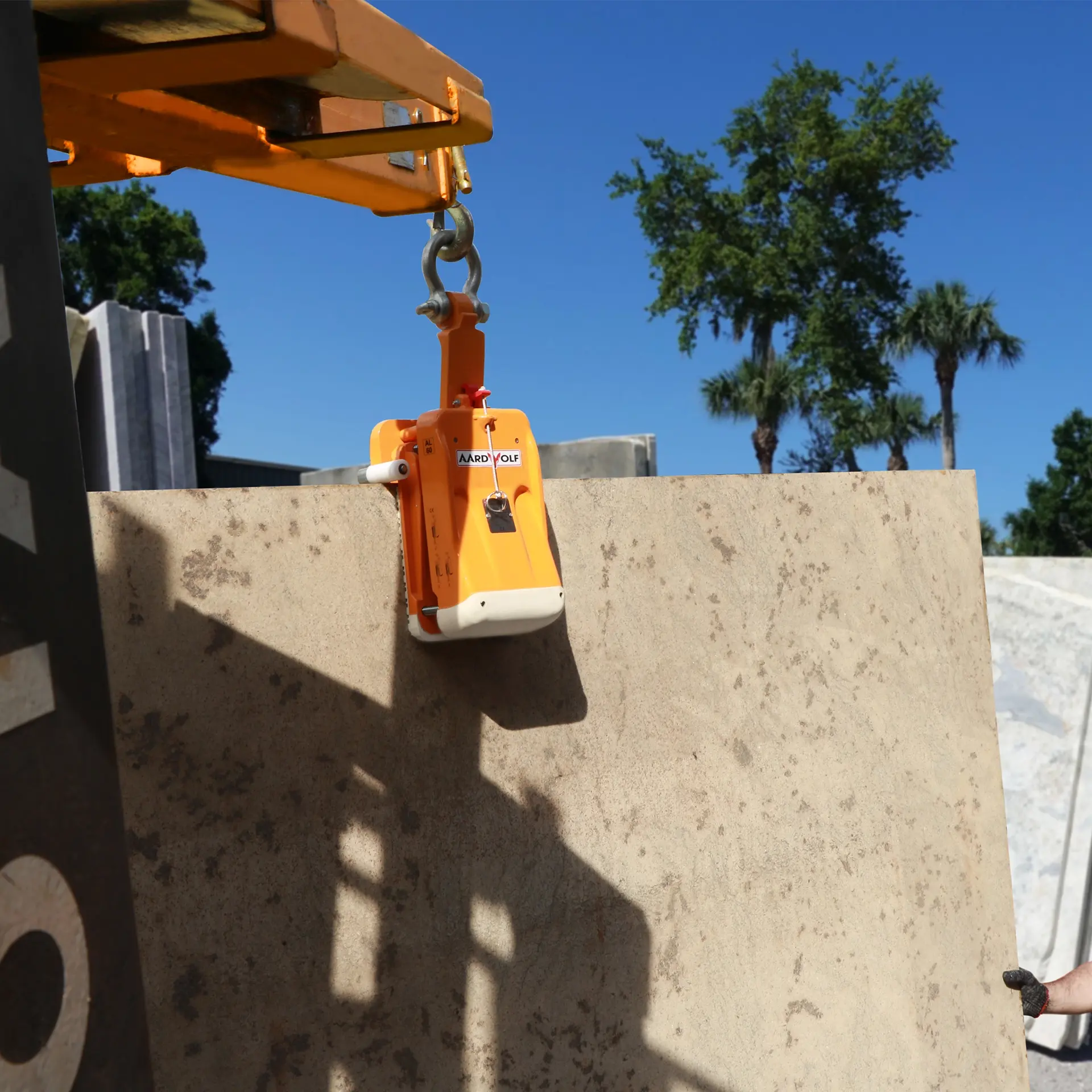
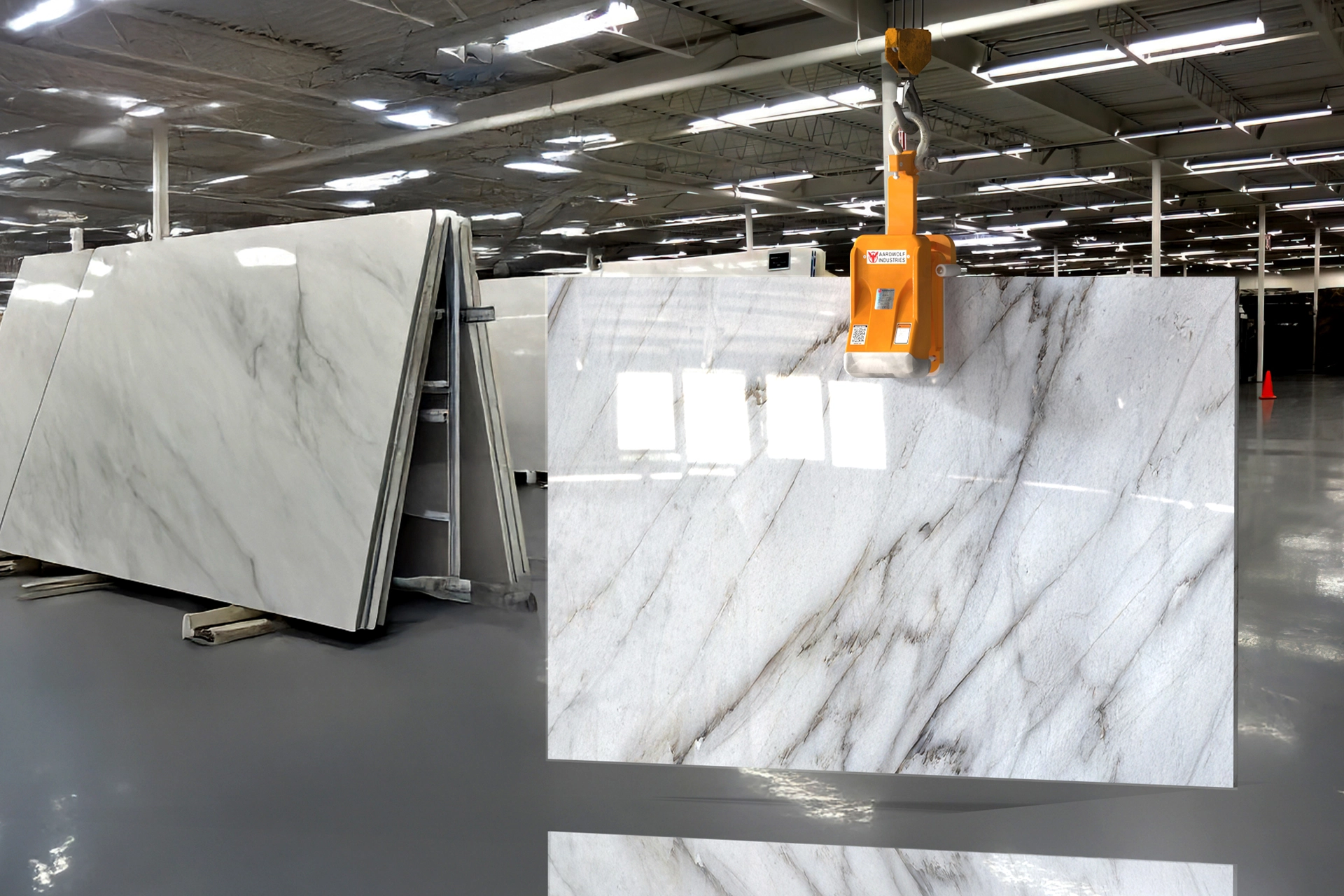
Granite, Marble and Stone Slabs
In stone fabrication, a slab typically passes through several handling stages, from storage and fabrication to repositioning, finishing, and dispatch. One piece of equipment therefore does not necessarily need to perform every part of the workflow.
Slab lifters grip and lift slabs from the edge. Vacuum lifters support lifting and positioning through the material surface when conditions are suitable. Trolleys and carts assist with movement around the workshop, while transport frames support storage and transportation. Forklift booms and lifting attachments can provide a different lifting point or additional reach when required.
Rather than selecting each piece of stone handling equipment in isolation, it is useful to look at the complete path of the slab and identify where unnecessary handling, difficult positioning, or risk of material damage is occurring.
Glass and Sheet Materials
For glass panels and other sheet materials, weight is only part of the handling requirement. Load orientation and the movement required between pick-up and placement can be equally important.
Depending on the application, glass lifters or vacuum lifters may provide different approaches to handling these materials. If a panel needs to move from horizontal to vertical before installation, tilt or rotation may become as important as lifting capacity. With vacuum lifting, the surface condition must also be suitable for establishing and maintaining the required vacuum.
The equipment specification should therefore reflect the complete movement from the pick-up point to the final position, including any change in orientation along the way.
Concrete, Blocks, Kerbs and Barriers
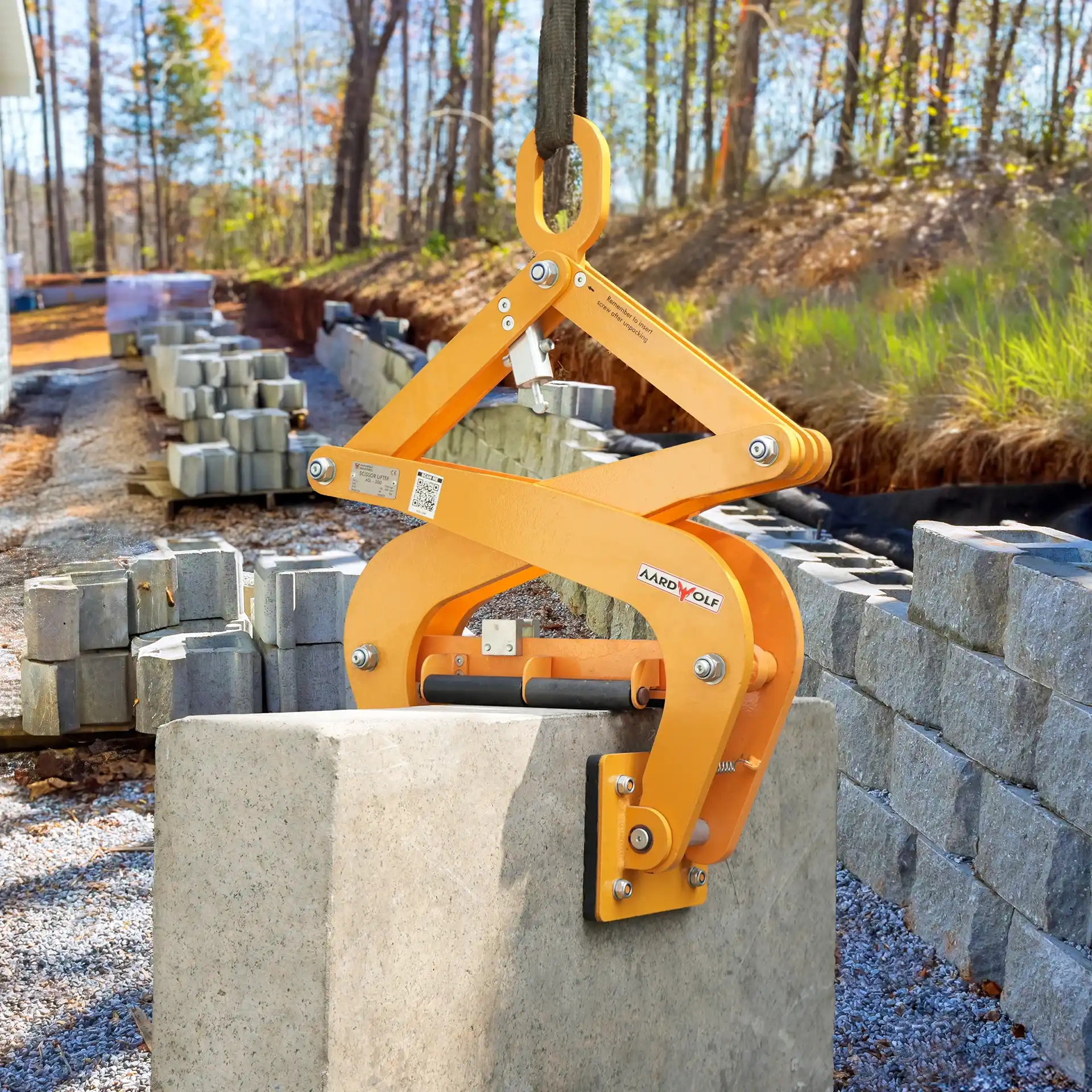
For concrete blocks, kerbs and barriers, load geometry has a direct influence on the gripping method.
In addition to W.L.L., factors such as grip range, jaw configuration, and available contact area need to be considered. Block clamps, barrier lifters and scissor lifters are designed for different load shapes and handling requirements.
A clamp may have sufficient lifting capacity but still be unsuitable if its jaws cannot make proper contact or its grip range does not match the actual dimensions of the load. Capacity and load geometry should therefore be assessed together.
Bags and Sacks
For cement bags, food ingredients and industrial sacks, the main challenge is not always the weight of one bag. It may be the need to repeat the same movement continuously during palletising, depalletising or production-line feeding.
Forklifts are effective for moving pallets but do not directly address the repetitive lifting and positioning of individual bags. Where appropriate, a vacuum tube lifter can support the load so the operator primarily guides its movement and placement.
Selection should therefore consider bag weight and surface, handling frequency, pick-and-place height, pallet position, workspace layout, and crane reach. These factors determine whether the system suits the complete lifting cycle rather than simply the weight of the bag.
Forklift Material Handling
Forklift attachments can extend the applications of an existing forklift, particularly when a different lifting point or greater reach is required. However, the capacity of an attachment is not the capacity of the complete forklift-attachment system.
The attachment has its own weight and changes the position of the load. With a telescopic forklift boom, the loading conditions also change as the lifting point extends farther from the forklift.
The forklift, attachment, load, and lifting position should therefore be assessed as a complete system rather than relying only on the W.L.L. stated for the attachment.
Material Protection Is Also Part of ROI
In stone handling, the cost of the equipment is only one part of the financial equation. A slab that has already been cut, fabricated and finished contains both the value of the material and the work already invested in it.
If a slab is chipped, cracked or otherwise damaged during handling, the consequences may include rework, replacement, additional handling and schedule disruption. When selecting a slab lifter, W.L.L. and grip range are therefore only the starting specifications. How the jaws contact the slab and how gripping force is transferred into the material also matter.
On Aardwolf Slab Lifters, the moving jaw travels along rigid guide rails and remains parallel to the slab surface under load. This helps maintain the contact area and distribute gripping force more evenly rather than concentrating it within a smaller area.
For granite, marble and other high-value slabs, the objective is not simply to lift the material. It is to move it to the next stage while protecting the value already created through fabrication and finishing. From this perspective, material protection becomes part of the return on investment.
What Should Be Checked Before Buying Lifting Equipment?
What Can the Forklift Actually Lift with the Attachment Installed?
When using a forklift boom or another lifting attachment, the attachment capacity should not be treated as the default capacity of the complete system.
Attachment weight, load position and the distance of the lifting point can all affect the forklift's actual lifting capability. With telescopic booms, these conditions continue to change as the boom is extended.
Before selecting an attachment, the intended working configuration should therefore be assessed as forklift + attachment + load + lifting position. This provides a more useful basis for selection than comparing attachment W.L.L. values alone.
Does the Equipment Meet Project HSE Requirements?
For infrastructure, EPC and other sites operating under defined HSE procedures, the ability to perform the lifting task is only part of the requirement. Supporting documentation may also affect whether equipment can be accepted for use on site.
Depending on project requirements, this may include W.L.L. marking, equipment identification, technical documentation, manufacturer test documentation, and applicable inspection or certification requirements.
Checking these requirements during specification and procurement helps reduce the risk of equipment arriving on site before the required documentation has been confirmed.
How Operator-Dependent Is the Handling Process?
The same equipment may be used by several operators during its service life. If a handling cycle relies heavily on individual judgement, changes in operators can also change how the equipment is used.
Depending on the application, features such as automatic locking, gravity-operated gripping, load monitoring, or vacuum-loss warnings can make equipment status clearer and support more consistent handling.
These features do not replace training, inspection or safe operating procedures. They can, however, reduce unnecessary steps that depend on individual operator judgement.
What Happens When a Wear Part Needs Replacing?
Rubber pads, vacuum pads and other wear components require inspection and replacement during the life of the equipment. Maintainability should therefore be considered before purchase.
It is useful to establish which components can be replaced individually, which spare parts are available, and how quickly replacements can reach the site. A component may cost very little compared with the equipment itself, but if the equipment cannot operate while waiting for that part, downtime can become more significant than the cost of the spare part itself.
Standard or Custom Material Handling Equipment?
Standard and custom equipment should not be viewed as basic and premium alternatives. Each has its own advantages, and the right choice depends on the application.
| Option | Suitable when | Main advantages |
| Standard equipment | Load, dimensions, movement and working conditions fall within an established model's design range | Defined specifications, straightforward selection, established configuration, and easier operation, maintenance and spare-parts management |
| Custom equipment | The application has specific geometry, dimensions, movement, equipment interfaces or working conditions | The design can be adapted around the load, workflow, equipment interface and project requirements |
When a standard model fully meets the application, its established configuration can make selection, operation and maintenance more straightforward. This is a practical advantage for common applications with clearly defined requirements.
Custom equipment addresses a different need. If the load has unusual geometry, requires a specific movement or must integrate with an existing production setup, adapting the equipment to the application may be more practical than changing the entire workflow around an available configuration.
With engineering and manufacturing capabilities in India, Aardwolf India can provide both standard material handling equipment and project-specific solutions. The decision between them is based on the actual load and workflow requirements rather than assuming that one approach is inherently better than the other.
Look Beyond the Purchase Price
Purchase price matters, but it does not represent every cost that may appear once equipment enters service. Two pieces of industrial material handling equipment with similar lifting capacities can have very different effects on workflow and operating costs.
| Operational issue | Potential impact |
| Material damage | Rework, replacement or loss of value already added during fabrication |
| Repeated repositioning | Longer handling cycles |
| Repetitive manual handling | Greater difficulty maintaining a consistent workflow as handling frequency increases |
| Poor equipment fit | Additional lifting, repositioning or handling steps |
| Equipment downtime | Production or site schedule disruption |
| Long spare-parts lead times | Longer periods out of service |
| Difficult maintenance | Additional time and cost required to keep equipment operational |
For this reason, comparing equipment by purchase price alone can overlook costs that appear later in operation. At the same time, a higher purchase price does not automatically mean better performance.
A more useful comparison considers application fit, material protection, workflow efficiency, maintainability, spare-parts availability and expected service life together. The objective is to understand how the equipment will perform throughout the actual workflow, not simply whether it meets the required lifting capacity on paper.
What Information Helps Select the Right Equipment?
A buyer does not necessarily need to know the model number before requesting a recommendation. In many cases, an accurate description of the application provides a better starting point.
| Information | What to identify |
| Load | Material type, dimensions and maximum weight |
| Contact | Surface condition, geometry and available gripping areas |
| Movement | Lift, move, tilt, rotate or position |
| Existing equipment | Forklift, crane, hoist or existing production system |
| Workspace | Pick-and-place positions, available space and working environment |
| Frequency | Handling frequency and operating cycle |
| Project requirements | HSE, documentation and site-specific requirements |
Additional information will depend on the application. For bag handling, this may include bag surface, pallet height and lifting frequency. For forklift attachments, the forklift configuration and intended working position are important. For custom projects, drawings, photographs and a description of the existing workflow can help the engineering team understand the operating conditions more accurately.
With this information established, Aardwolf India can match the application to an existing standard model or develop a customised solution where the project requires it.
The objective is not to select the material handling equipment with the highest specification, the most features, or the most customised design. It is to select equipment that fits the load, the required movement and the actual operating conditions. By evaluating the complete application from the beginning, material protection, safety, workflow and long-term operating costs can all form part of the same equipment decision.