



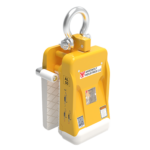
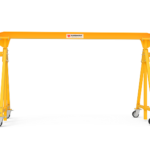
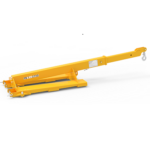




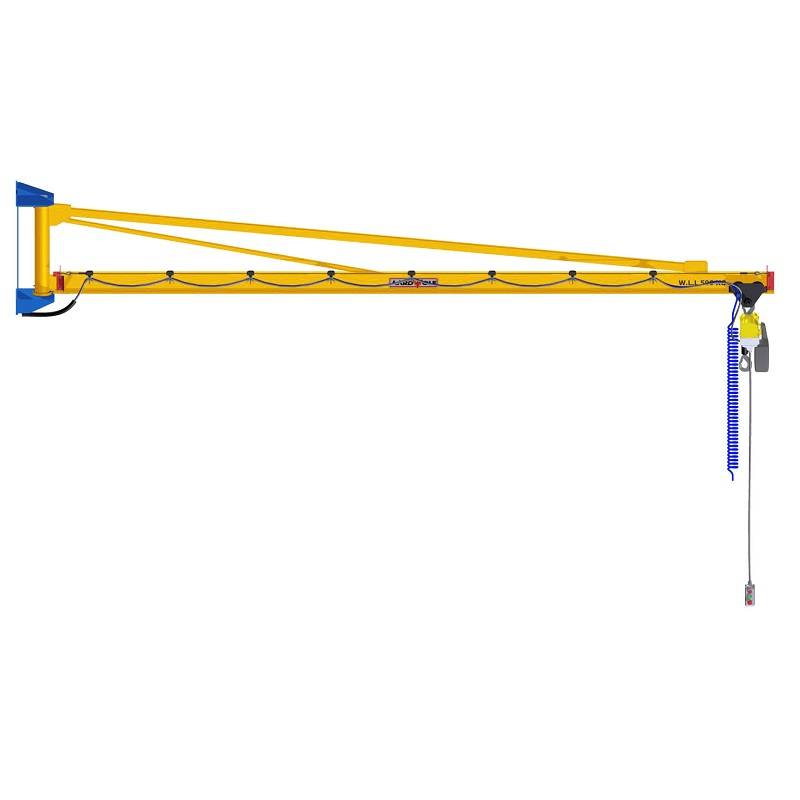
When teams ask “What capacity should our jib crane be?”, the honest answer is: it depends on the application. The same 2-ton nameplate can be perfectly sized in one bay and dangerously undersized in another. That’s because jib crane load capacity is not a single static number—it’s the safe lifting limit at a given radius, duty profile, mounting condition, environment, and rigging configuration. This guide explains why capacity varies, how to size for your use case, and where engineers typically land for different industries.
Table of Contents
ToggleWhat “capacity” really means (and why it moves)
A jib crane is a cantilever: the farther out the hook travels, the higher the bending moment at the mast or bracket. Manufacturers publish capacity-at-radius curves (or they embed limits in the model selection), so the true usable capacity changes with where you lift, how often, and under what conditions.
Below are the major variables that push your effective capacity up or down.
1) Working radius & moment
- Closer to the mast = higher effective capacity; near the boom tip = lower capacity.
- Long-reach picks produce larger moments, demanding stiffer booms, stronger brackets, and/or foundation upgrades.
Implication: A “2-ton” jib might only handle 2 tons near mid-span but require derating at maximum outreach.
2) Duty cycle & dynamics
- High starts/hour, fast accelerations, frequent inching, and quick rotates increase dynamic loads.
- Shock loading (snags, sudden stops, side pulls) can spike forces well above the static weight.
Implication: The same load may need a higher jib crane load capacity in a 24/7 cell than in occasional maintenance picks.
3) Mounting type & supporting structure
- Wall-mounted jibs push loads into building columns or frames; capacity is limited by the structure.
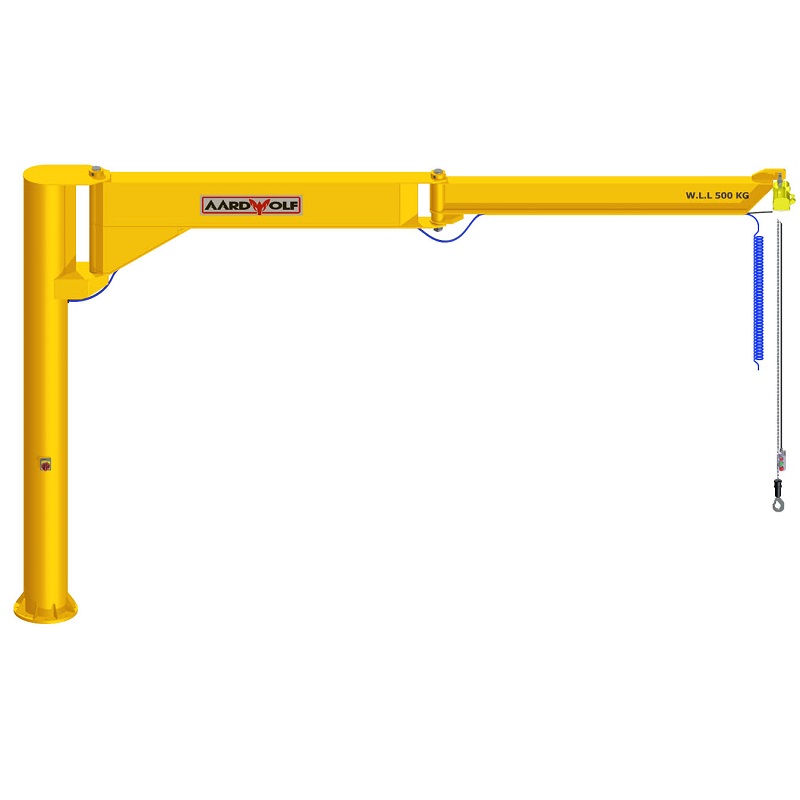
- Freestanding jibs develop capacity from a dedicated foundation; bigger footings unlock higher tonnages.
- Mast-type jibs rely on both floor anchorage and an upper tie—capacity depends on the tie-point’s strength.
Implication: Your building—not just the crane—sets the ceiling for capacity.
For practical wall-mount envelopes and tips, see Which Jib Crane Load Capacity Suits Wall-Mounted Models?
4) Environment & conditions
- Outdoor wind adds overturning moments; heat stresses motors and controls; corrosion weakens members; dust and chemicals affect bearings and electrics.
Implication: Tough conditions require derating and/or upgraded specs (coatings, IP ratings, heaters, explosion-proof packages).
5) Below-the-hook gear & rigging geometry
- Clamps, spreaders, slings, magnets, and beams add dead weight and can alter load paths.
- Sling angles and off-center CGs multiply line loads and risk side pulls.
Implication: Always include rigging mass and geometry when calculating capacity.
6) Headroom, deflection & precision needs
- Excessive tip deflection slows load positioning and tempts operators into unsafe side pulls.
- Tight headroom forces shorter hoists or cantilever changes that can alter capacity.
Implication: A stiffer boom (often a higher-capacity model) may be chosen purely for precision even if static loads are modest.
7) Safety margins & compliance
- Engineers add typical allowances: ~15% for hoist/trolley weight and ~10–25% for dynamics (application-dependent).
- Certain industries (e.g., food, pharma, critical infrastructure) apply conservative margins and stricter duty classes.
Implication: Two plants lifting the same part can specify different capacities due to policy and regulation.
How capacity shifts by application (with typical bands)
Below are illustrative ranges showing why the “right” jib crane load capacity changes case by case. Use them to frame your initial spec; validate with the manufacturer’s radius chart and your structural engineer.
Small workshops & SMEs
- Typical picks: tooling, fixtures, motor swaps, stone slabs, sheet bundles
- Common capacity band: 0.5–2 t (up to 3 t if lots of rigging mass or long outreach)
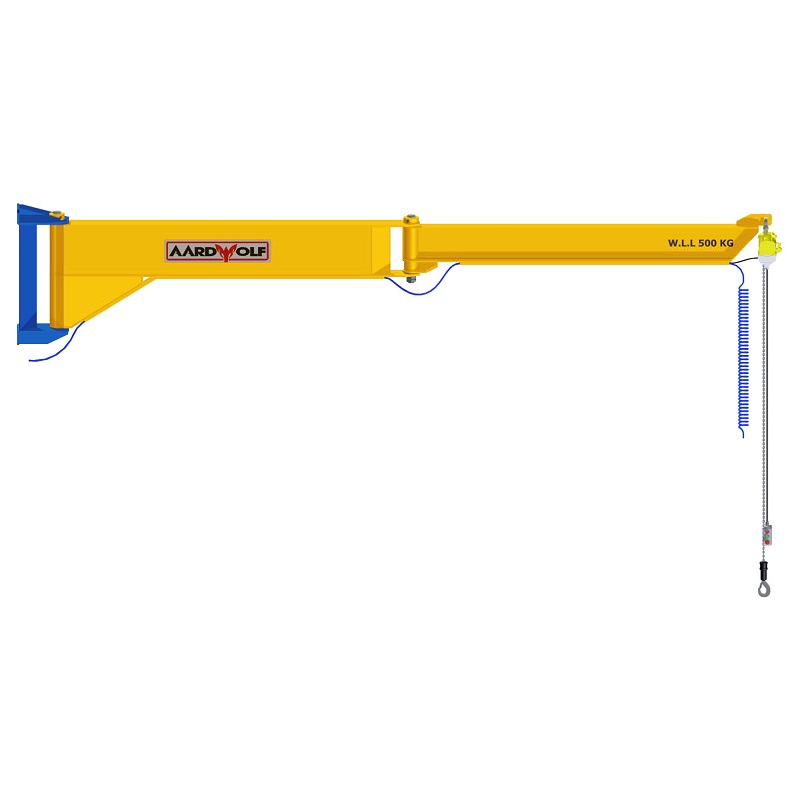
- Mounting: wall-mounted or mast-type to save floor space; articulated arms for obstacle-dense cells
- Why it varies: tight spaces (shorter jibs), lighter but frequent picks, building limits
See Which Jib Crane Load Capacity Fits Small Workshops Best for sizing patterns in compact shops.
Heavy industries & large fabrication
- Typical picks: dies/molds, welded modules, chassis, ship components
- Common capacity band: 5–10 t (and higher in specialized bays)
- Mounting: mostly freestanding with engineered footings; rotation controls and creep speed are common
- Why it varies: long reaches, high moments, abrasive environments, high duty
Explore What Jib Crane Load Capacity Works for Heavy Industries for big-bay scenarios.
Maintenance, repair & overhaul (MRO)
- Typical picks: pumps, gearboxes, motors, tool changes
- Common capacity band: 1–3 t
- Why it varies: intermittent duty but diverse rigging; need for reach over machinery; preference for wall mounts in crowded plants
Logistics & warehousing
- Typical picks: pallets, totes, long goods at docks
- Common capacity band: 0.5–2 t
- Why it varies: speed and ergonomics; many lifts at near-tip radius; mobile or wall-travel solutions favored
Food, pharma, and clean environments
- Typical picks: stainless vessels, tooling, packaged product
- Common capacity band: 0.5–1 t (sometimes 2 t)
- Why it varies: stainless or coated builds, cleanroom electrics, conservative safety factors
A quick, application-first sizing method
Use this thin-slice workflow to land on a defendable starting capacity in minutes. Then refine with the vendor’s boom charts.
Step 1 — Define the heaviest routine lift
- Don’t design around once-a-year emergencies. Note the heaviest regular load (W_load).
Step 2 — Add rigging & below-the-hook gear
- Clamps, spreaders, slings, shackles, magnets (W_rig).
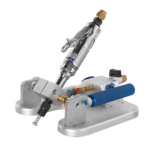
- For stone, include the clamp mass; some workshops use miter setups that add weight—see Aardwolf Stone Miter Clamps.
Step 3 — Apply an application factor
- Start with ×1.25 (15% hoist/trolley + ~10% dynamics).
- Increase for harsh duty (fast cycles, impact) or poor floor conditions.
Step 4 — Check at radius
- Compare your working radius (R_work) against the vendor’s capacity-at-radius curve.
- Lots of near-tip picks? Up-select capacity or shorten the boom.
Step 5 — Confirm structure & environment
- Wall/column strength (for wall-mounts), foundation design (for freestanding), corrosion/washdown needs, wind if outdoors.
- For obstacle-heavy cells, consider an articulated arm such as the Articulated Jib Crane – Wall Mounted.
Worked example (fabrication cell)
W_load = 1.60 t (steel weldment)
W_rig = 0.10 t (spreader + slings)
Application factor = ×1.25 ⇒ 1.70 × 1.25 = 2.13 t
Jib radius used most: 4.5 m (near 80% of boom)
Select 2.5 t class, verify vendor curve at 4.5 m, and add VFD hoist with creep speed for precise set-downs.
For where engineers typically settle (and why), review What Jib Crane Load Capacity Engineers Commonly Choose.
Why two identical lines can require different capacities
Even with the same product and same boom length, capacity choices can diverge for good reasons:
- Different rigging: One line uses a spreader and dual slings; the other uses a clamp (heavier).
- Different throughput: Line A cycles 60 times/hour; Line B cycles 10 times/hour → higher dynamics in A.
- Different reach usage: Line A lifts mid-span; Line B almost always lifts at max radius.
- Different structures: Line A is on a freestanding base; Line B is wall-mounted to a light column.
- Different environments: Heat, corrosives, outdoor wind, washdown.
- Different safety policy: Some sites mandate larger margins and stricter deflection limits.
In short: context changes capacity.
Mistakes that quietly reduce your real capacity
- Sizing by headline tonnage, not by radius
- Ignoring rigging weight and sling angles
- Underestimating duty/dynamics (inching, quick starts, rotation stops)
- Skipping a structural check (bracket loads, anchor pull-out, slab thickness)
- Overlooking environment (wind/heat/corrosion derating)
- Accepting excessive deflection (leads to side pulling and premature wear)
Matching capacity to mounting type (fast decision cues)
- Wall-mounted (tie-rod or cantilever): best where floor space is scarce. Realistic capacity typically ≤ 2–5 t depending on the building.
Learn more: Which Jib Crane Load Capacity Suits Wall-Mounted Models? - Mast-type: uses upper tie + floor anchorage. Good for ≤ 5 t and 360° rotation without a massive footing.
- Freestanding: engineered foundation unlocks 5–10 t (and beyond in special cases), 360° coverage, and the best stiffness at reach.
If your applications span light, small-bay work and heavy-shop modules, you may need different jibs across departments. See What Jib Crane Load Capacity Works for Heavy Industries (heavy bays) alongside Which Jib Crane Load Capacity Fits Small Workshops Best (compact cells).
Selecting capacity: a practical checklist
Application
- Max routine load + rigging
- Typical radius and height
- Precision needs (creep speed, rotation control)
Duty & controls
- Starts/hour, run time/hour, need for VFDs and soft-stop
- Thermal class and braking requirements
Structure & installation
- Wall/column capacity (wall-mount)
- Foundation design (freestanding)
- Headroom limits and interferences
Environment
- Outdoor wind limits, coatings, IP ratings, heaters
- Washdown or corrosion resistance
Safety & compliance
- Overload limiters, upper/lower/rotation limits
- Site-specific safety factors
Lifecycle & support
- Spares, service access, training
- Standardization across cells to simplify maintenance
Bringing it together: capacity that fits your application
The “right” jib crane load capacity is the smallest capacity that safely and comfortably does your job—at your working radius, frequency, and environment—with enough stiffness for precise placement and headroom for dynamics. That’s why capacities vary so widely across applications and why smart teams standardize a selection method rather than chasing a single number.
- For tight cells with obstacles, consider an articulated wall-mounted model: Articulated Jib Crane – Wall Mounted.
- If you’re balancing multiple bays and workflows, align choices with the patterns in What Jib Crane Load Capacity Engineers Commonly Choose, cross-checked against heavy-industry needs and small-workshop realities.
- Ready to compare models? Browse more crane products.
Quick FAQ
Q: Can I just buy extra capacity “to be safe”?
A: Oversizing adds cost and can hide structural and foundation issues. You still must verify radius, structure, duty, and deflection. Buy fit-for-use capacity with the right boom and controls.
Q: Our lifts are light but frequent and precise. Should we upsize?
A: Maybe. Many teams choose a stiffer (sometimes higher-capacity) boom primarily to minimize deflection and improve accuracy—even if static loads are small.
Q: How much safety margin is enough?
A: A common starting point is ~15% for hoist/trolley mass plus ~10–25% for dynamics. Increase margins for harsh duty or strict site policies.
Bottom line: Capacity varies because applications vary. Size your jib crane load capacity by radius, duty, mounting, environment, and rigging—and you’ll land on a safe, productive, and economical spec tailored to your operation.
Please log in to leave a comment.