







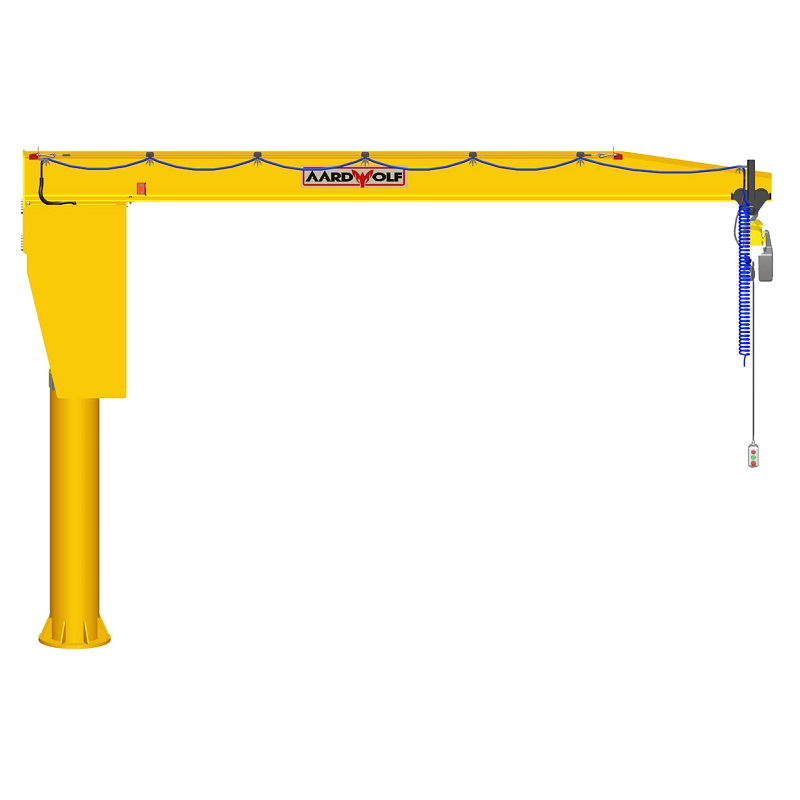
Getting jib crane selection right isn’t only about productivity—it’s a compliance issue. From OSHA obligations and ASME/ANSI design rules to insurance and corporate safety policies, jib crane load capacity is one of the most scrutinized specifications on your shop floor. Underspec it and you invite fines, failures, and downtime. Overspec it without proper structural verification and you can still be out of compliance. This article breaks down why capacity is so central to regulations, how it connects to real-world operations, and the practical steps to prove (and document) you’re compliant.
Table of Contents
ToggleWhat “capacity” means in the eyes of compliance
Regulators and auditors focus on three intertwined ideas:
- Rated load (nameplate capacity). The maximum safe load under normal conditions, established by the manufacturer’s design and testing. This must be visible on the crane and match the installed configuration.
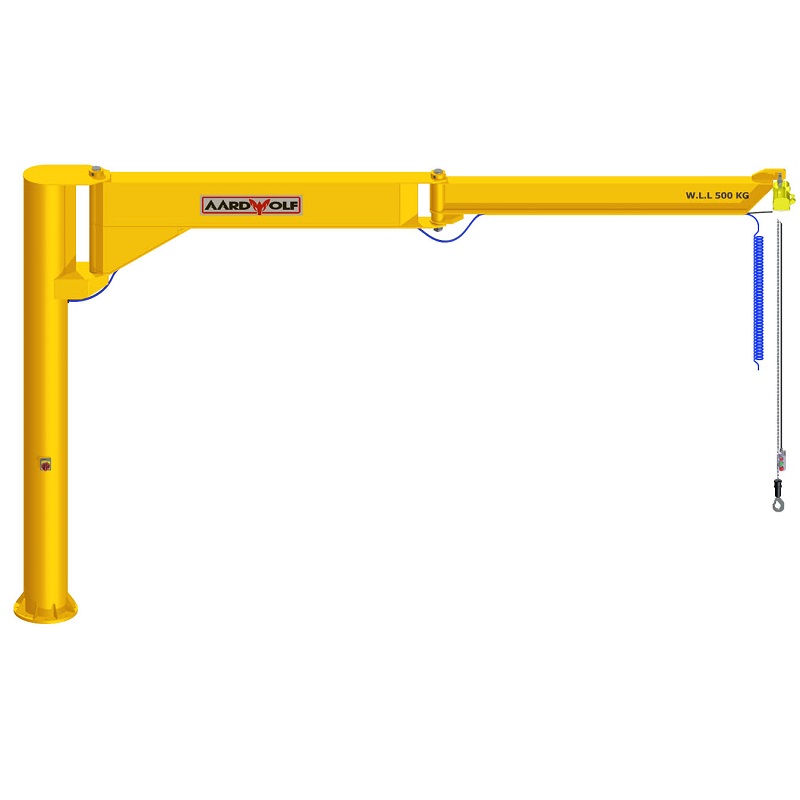
- Effective capacity at radius. Because a jib is a cantilever, usable capacity depends on load radius. Compliance expects you to respect the manufacturer’s capacity-at-radius curve (or embedded limit).
- System capacity. Not just the crane: building columns, anchors, foundations, and the below-the-hook (BTH) gear also set the real limit. A compliant system verifies every link in the chain.
Bottom line: Compliance is not “the boom says 2 tons”; it’s “this complete installation, at this radius, with this rigging, safely supports the load—documented.”
The compliance stack: where capacity shows up
1) Standards and codes (design & use)
- Design/manufacturing standards for jibs and hoists (e.g., ASME/ANSI B30 family) require that jib crane load capacity reflect strength, stability, and deflection limits.
- Use/operation standards require posting the rated load, training operators on limits, and prohibiting overloading and side pulling.
2) Workplace safety law (OSHA-style rules)
- Requires employers to provide equipment that’s adequate for the task, maintained, inspected, and used within its rated capacity.
- Expects proof: inspection logs, test certificates, and corrective actions when nonconformities are found.
3) Company policy & insurance
- Most insurers mirror standards but often demand more conservative safety margins, proof of commissioning tests, and documented operator training tied to each crane’s rating.
Where capacity decisions trigger compliance risk
A) Wall-mounted vs. freestanding: the structure is part of the capacity
A wall-mounted jib may be perfectly engineered—yet noncompliant if the supporting column can’t carry the moment and shear at full radius. Compliance requires:
- Structural check (calcs or PE stamp) of the column/wall and anchors.
- Clear posting of rated load and allowable outreach (if derated by reach).
If you’re comparing wall mounts, this deep dive helps:
Which Jib Crane Load Capacity Suits Wall-Mounted Models?
B) Dynamic duty (starts/hour, shock, rotation)
Even light parts can break rules under high-cycle use. Frequent start/stop, inching, and fast rotation introduce dynamic amplification. To stay compliant:
- Select a duty class that matches your throughput and cycle profile.
- Apply a sensible application factor (often 10–25%) beyond static weight.
For a practical look at application-driven selection, see:
What Jib Crane Load Capacity Engineers Commonly Choose
C) Harsh environments (wind, heat, corrosion)
- Outdoor wind adds overturning moments; compliance may require derating above certain wind speeds.
- Heat, dust, or chemicals necessitate protected electrics, coatings, and sometimes explosion-proof gear; capacity can change with these packages.
D) Below-the-hook gear & rigging geometry
Clamps, spreaders, magnets, slings, and shackles add dead weight and change load paths. Auditors often find:
- Rated load was calculated without rigging weight.
- Sling angles created line tension far above the hook load.
Result: unintentional overloads and noncompliance.
A capacity-first method that stands up to audits
Use this 5-step, paper-trail-friendly process. It’s simple, defensible, and trains well:
- Define the heaviest routine lift (not the one-off).
Record part IDs, drawings, and weight sources. - Add BTH & rigging mass.
List each component and weight (spreader, clamps, slings, shackles, magnets). For stone and benchtop fabrication, heavier jigs and clamps matter—see Aardwolf Stone Miter Clamps for typical rigging mass considerations:
miter clamps - Apply an application factor (≥1.15 to 1.25 typical).
- +15% for hoist/trolley mass is common in jib design.
- +10–25% for dynamics depending on duty and handling style.
Document your chosen factor and rationale.
- Verify at working radius using the maker’s curve.
If most picks happen near the boom tip, either upsize capacity or shorten the radius. Note the dominant radius on your lift plan. - Close the loop on structure & environment.
- Wall-mount: column check, anchor calcs, torque logs.
- Freestanding: foundation design and concrete test reports.
- Environment: wind limits, IP ratings, coatings, heaters.
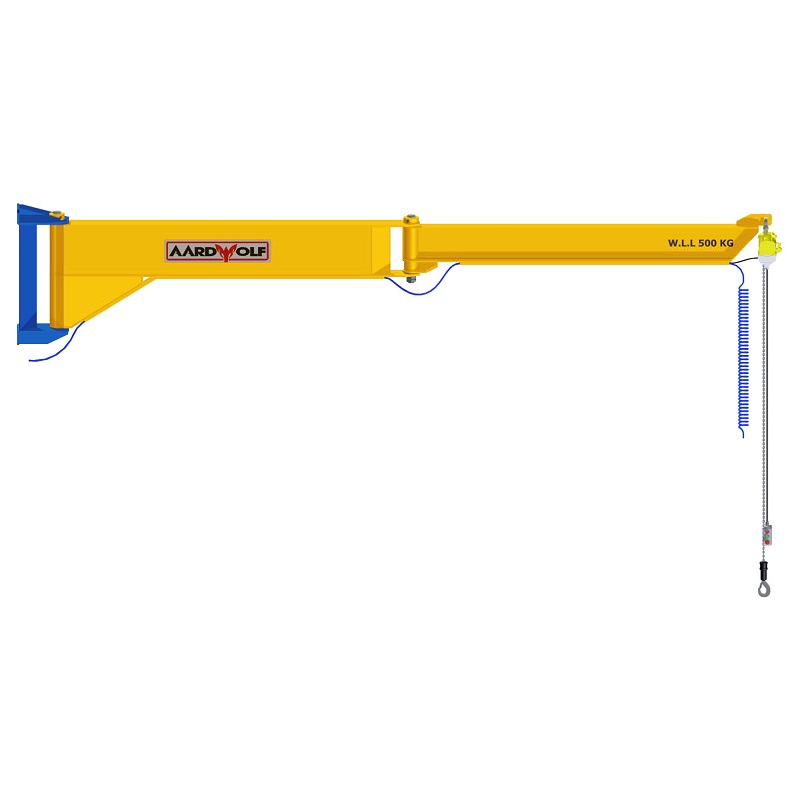
Pro tip: If obstacles or tight cells force awkward approaches, an articulated wall-mount can keep lifts vertical and compliant:
Articulated Jib Crane – Wall Mounted
Documentation that proves compliance (and saves you in audits)
- Nameplate & capacity signage. Include any derating by radius and special notes (e.g., “Not for side pulling”).
- Commissioning test report. Record proof load, radius, deflection, limit switch verification, brake test, and functional checks.
- BTH device certificates. Keep WLL tags and inspection records for clamps/spreaders; audit trail must link the device to the crane.
- Periodic inspections. Daily/shift checks logged by operators; frequent and periodic inspections by qualified persons with findings and corrective actions.
- Change control. Any change in boom length, hoist, trolley, or mounting is a configuration change → review capacity and re-post ratings.
Common capacity pitfalls that create noncompliance
- Using headline tonnage without radius context.
Compliance expects you to obey capacity at the actual outreach. - Ignoring rigging weight and sling angles.
The hook “sees” the vector sum—line tension can exceed the nameplate even when the hook load looks fine. - Relying on unverified structures.
Wall-mounts need column checks; freestanding bases need the right footing—or you’re out of step with the standard. - Skipping deflection criteria.
Excessive boom deflection can cause side pulls and edge loading—both compliance red flags. - No operator-specific training.
“Crane training” isn’t enough—operators must know this crane’s rating, radius limits, and signals.
How capacity ties to different applications (and why rules treat them differently)
- Small workshops & SMEs. Typical compliant choices: 0.5–2 t with wall/mast mounts, documented column checks, and simple BTH. For a selection lens tuned to compact spaces, read:
Which Jib Crane Load Capacity Fits Small Workshops Best - Heavy industries. Frequent long-radius picks, abrasive environments, and higher duty cycles push compliant choices toward 5–10 t freestanding systems with engineered footings. See:
What Jib Crane Load Capacity Works for Heavy Industries - Engineer-led programs. Many teams standardize around repeatable bands (e.g., 1 t, 2 t, 3.2 t, 5 t), chosen for radius coverage, stiffness, and shared spares. Rationale here:
What Jib Crane Load Capacity Engineers Commonly Choose - Mixed environments and evolving lines. If your load families or workflows vary, establish a capacity matrix by bay or product family and embed it in your lift plans. Update the matrix when products or processes change.
For a deeper explanation of why capacity changes from site to site, this overview helps your training and audits:
Why Jib Crane Load Capacity Varies Across Applications
Practical examples (audit-ready scenarios)
Example 1 — Stone fabrication cell (wall-mounted, tight reach)
- Heaviest slab + A-frame + BTH clamp = 850 kg total.
- Dynamics factor 1.25 → 1,062 kg.
- Frequent picks near 85% of boom length; building column verified to 1.5× moment.
- Posted capacity: 1,000 kg at ≤85% radius; training explicitly bans side pulls.
- Compliance win: derated signage, column calc on file, clamp WLL certs.
Example 2 — Heavy assembly (freestanding, long radius)
- Load 3,200 kg + spreader/rigging 250 kg = 3,450 kg.
- Duty factor 1.25 → 4,313 kg.
- Vendor curve shows 5 t model supports 4.3 t at 4.8 m radius; foundation designed per vendor spec; proof test at 110% performed at radius.
- Posted capacity: 5 t general, table of allowable load vs. radius attached on mast.
Training & signage: the last mile of compliance
- At-a-glance limits: Put a small radius vs. capacity chart at eye level near the pendant.
- No side pull: Add a pictogram (hook plumb only).
- BTH reminders: Post a rigging checklist: Verify WLL tags, sling angle, and clamp engagement before lift.
- Emergency response: Clear instructions on E-stop, overload indicators, and lockout/tagout.
Make capacity compliance easier with the right hardware
- Articulated arms help maintain vertical lifts in obstacle-dense cells, which reduces side-pull violations and operator workarounds:
Articulated Jib Crane – Wall Mounted - Standardize across sites where possible; it simplifies training, inspections, and spare parts.
- Planning a refresh or expansion? Browse more crane products to align models with your compliance strategy from day one.
Key takeaways
- Compliance hinges on capacity. Not just the nameplate—the full system: crane, structure, BTH, radius, duty, and environment.
- Document everything. Calculations, commissioning tests, inspections, signage, and training close the compliance loop.
- Design for how you actually lift. If most picks are near the tip, choose the boom and capacity to suit that reality—or derate and post clearly.
- Train to your site conditions. Operators must understand your capacity chart, at your radius, with your rigging.
Get capacity right and you’ll be safer, more productive—and confidently compliant.
Please log in to leave a comment.