








In modern manufacturing, logistics, construction, and heavy industry, material handling efficiency often determines how profitable—and how safe—an operation can be. Among the many lifting solutions available, jib cranes remain one of the most practical tools for localized lifting because they combine flexibility, fast positioning, and minimal space usage. But the key factor that defines how effective a jib crane will be in any facility is its jib crane load capacity. The right capacity helps operations run smoothly, reduces equipment strain, and improves worker safety. The wrong capacity—whether too low or too high—can create hidden costs, workflow bottlenecks, and long-term compliance risks.
This guide explains how jib crane load capacity shapes industrial applications, why capacity needs differ by industry, and how to select the best rating for real workplace conditions.
Table of Contents
ToggleWhy Jib Crane Load Capacity Matters in Industrial Applications
At first glance, jib crane capacity seems simple: it’s the maximum weight a crane can lift safely. But in real industrial environments, capacity determines far more than “how heavy” a crane can lift.
In practice, jib crane load capacity directly influences:
- Safety margins and accident prevention
- Productivity (how fast loads can move)
- Crane durability (how long components last under stress)
- Hoist and trolley selection
- Mounting and foundation requirements
- Compliance with standards and inspection requirements
A crane that runs too close to its capacity every day will wear faster and require more maintenance. A crane rated far above your needs could cost more than necessary and may require expensive reinforcement of floors or structures.
So the real goal is not “choose the biggest crane,” but rather:
✅ choose the correct jib crane load capacity for your tasks, workspace, and duty cycle.
Understanding Jib Crane Load Capacity (Rated vs Real-World Load)
A crane’s rated capacity is determined under standardized conditions, but real-world loads include more than the product being lifted.
What counts in real-world load?
When calculating actual lifted weight, include:
- The load itself (materials, components, equipment)
- Rigging gear (slings, chains, hooks, spreader bars)
- Lifting attachments and clamps
- Any load shift or uneven distribution
- Dynamic forces from starting/stopping the hoist
- Potential impact loading from rapid movement
That’s why engineers often recommend a 10%–20% capacity margin for most industrial environments.
For instance:
- Maximum load = 2,000 kg
- Rigging + attachments = 150 kg
- Shock/dynamic allowances = 10%–20%
➡️ Ideal crane capacity might be 2.5 tons or 3 tons, not 2 tons.
How Capacity Shapes Different Industrial Applications
Different industries use jib cranes differently. Some perform high-frequency lifts all day. Others lift heavy loads only occasionally. Some require precise movement around obstacles. These factors change the “ideal” capacity.
Below are the most common industrial use cases and how jib crane load capacity shapes each one.
1) Manufacturing Plants: Matching Capacity to Production Flow
Manufacturing environments—automotive, machining, metalworking, fabrication—often require:
- repetitive lifting
- precise load positioning
- consistent cycle time
- reduced manual handling
In this setting, capacity is not just about the maximum load. It affects line efficiency.
What happens if capacity is too low?
- operators hesitate or slow down
- overload risk increases
- hoists wear faster
- production flow becomes inconsistent
What happens if capacity is well matched?
- faster load transitions
- smoother assembly operations
- reduced labor strain
- fewer breakdowns
Most manufacturing plants use jib cranes in the range of 0.5 ton to 10 tons, depending on the operation and materials.
2) Warehouses & Logistics: Capacity Determines Throughput
Warehouses, distribution centers, and logistics yards use jib cranes for:
- loading/unloading
- pallet movement
- staging heavy products
- repositioning parts in confined areas
Here, jib crane load capacity influences:
- how fast inventory can be moved
- how often the crane can be used without fatigue
- whether larger shipments can be handled safely
Warehouses often experience “load variability”—some days loads are light, other days heavier shipments arrive. That makes a capacity margin essential.
3) Workshops & SMEs: Capacity Affects Cost-Effectiveness
Small workshops and SMEs often want cranes that are:
- compact
- easy to install
- affordable
- reliable for daily tasks
In these environments, jib cranes are favored because they deliver powerful lifting capability in a tight footprint.
Typical capacity needs range from:
- 250 kg to 2 tons for light work
- 2 tons to 5 tons for fabrication, maintenance, or stone handling
For workshops handling stone slabs, machinery, or bulky products, a properly matched jib crane capacity prevents bottlenecks and protects workers from injury.
4) Construction Sites: Capacity Must Consider Unpredictability
Construction sites demand flexibility, and lifting conditions are rarely “perfect.”
Factors affecting capacity in construction include:
- wind loads
- uneven surfaces (especially with portable cranes)
- dynamic swings
- limited working clearance
- unpredictable load positioning
Because dynamic forces are common, construction jobs benefit from higher safety margins and careful capacity planning.
5) Heavy Industry: Capacity Becomes a Structural Engineering Decision
In shipyards, steel plants, mining environments, and heavy fabrication, crane capacity is rarely a simple purchase decision—it becomes an engineering system.
Heavy industries may require jib cranes rated:
- 5 tons to 16 tons
- or custom designs beyond standard ranges
At this level, capacity affects:
- foundation design
- mast thickness and reinforcement
- boom deflection control
- rotation bearing durability
- hoist duty classification
- long-term inspection requirements
This is where correct capacity selection impacts not only lifting performance but also facility engineering costs and compliance frameworks.
The Relationship Between Load Capacity, Reach, and Workspace Layout
An important point many buyers miss:
✅ Capacity is connected to reach (jib length).
A longer boom increases reach, but it can also increase bending forces and deflection. That means a crane rated for 3 tons at one jib length may not perform the same at a longer jib.
So capacity selection must consider:
- working radius
- jib length and span
- lifting height
- rotation range
- surrounding obstructions
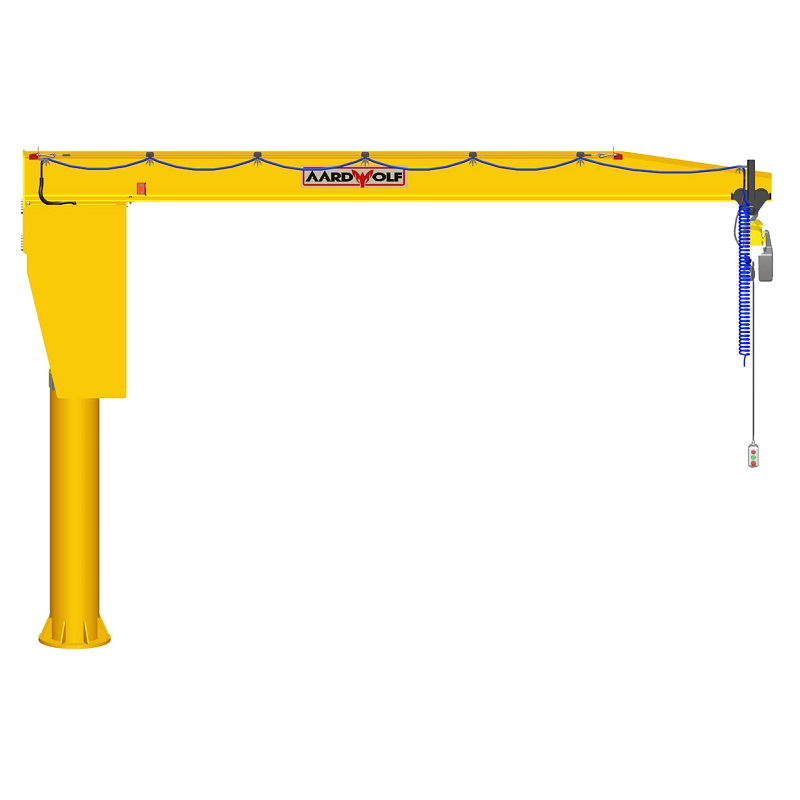
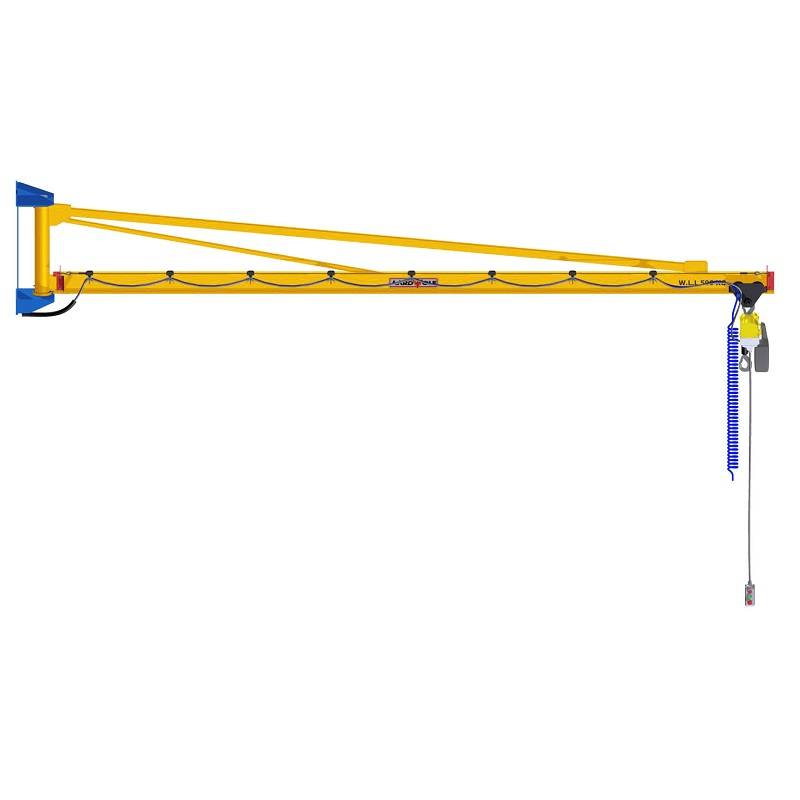
For environments with obstacles and tight workspaces, an articulated crane design may provide better load control without requiring oversized capacity.
You can explore one example here:
👉 Articulated Jib Crane – Wall Mounted
And for more configurations:
👉 more crane products
How to Choose the Right Jib Crane Load Capacity for Your Industry
Selecting capacity should follow a structured method.
Step 1: Define maximum lifted weight (including rigging)
Record:
- max load weight
- attachments
- slings and hooks
- tool fixtures
Step 2: Add safety margin
Most facilities use 10%–20%.
Outdoor or unpredictable operations may need more.
Step 3: Match capacity to frequency (duty cycle)
High-frequency lifting requires more robust crane components even at the same rated load.
Step 4: Confirm mounting feasibility
Wall-mounted cranes must rely on structural strength.
Floor-mounted cranes need suitable concrete foundations.
Step 5: Plan for future growth
If expansion or heavier loads are likely, choose capacity that prevents future upgrades.
Why Capacity Must Be Verified and Monitored On-Site
Even a properly rated jib crane can lose performance over time due to:
- corrosion
- metal fatigue
- loosened anchors
- worn hoist brakes
- damaged wire ropes
- bearing wear
- structural deflection changes
That’s why older cranes may need reassessment before continuing heavy operations:
👉 Why Old Jib Crane Load Capacity Needs Reassessment?
Tools and Tests That Help Confirm Capacity in Real Conditions
The most practical way to ensure safe capacity is verifying performance through inspections and tools such as:
- load cells and dynamometers
- deflection measurement tools
- calibrated test weights
- brake and control tests
- inspection logs and certification reports
To learn more about the inspection approach:
👉 What Jib Crane Load Capacity Tools Are Used On-Site
Why Real Applications Require More Than Just “Rated Capacity”
Real-world operations involve:
- uneven load distribution
- shifting loads
- impact forces
- operator variability
- environmental conditions
This is why capacity selection must be treated as an operational strategy, not just a specification.
For a deeper discussion on practical outcomes and real applications, refer to:
👉 How Jib Crane Load Capacity Affects Real-World Applications?
Common Mistakes That Reduce Crane Efficiency and Safety
Even with a correct capacity rating, operations fail when businesses make these mistakes:
❌ Underestimating rigging weight
Hooks and slings add real load weight.
❌ Ignoring dynamic loading
Sudden hoist starts/stops increase stress.
❌ Side pulling
Side loads can damage the boom structure.
❌ Skipping inspections
Small wear becomes structural risk over time.
❌ Choosing capacity without duty cycle planning
High-frequency lifting requires higher durability, not just higher tonnage.
Conclusion: Jib Crane Load Capacity Shapes Industry Performance
A jib crane is designed to make lifting simpler, safer, and faster—but only if its jib crane load capacity matches the real conditions of your workplace.
Capacity shapes industrial applications by determining:
- what loads you can lift safely
- how efficiently you move materials
- how durable your crane remains over time
- how your facility supports installation
- how well you meet inspection and compliance needs
Whether you operate a small workshop, warehouse, construction site, or heavy industry facility, capacity should be selected based on load reality—not guesswork.
To continue building your content cluster on this topic, include these related guides:
- 👉 Why Old Jib Crane Load Capacity Needs Reassessment?
- 👉 How Jib Crane Load Capacity Affects Real-World Applications?
- 👉 What Jib Crane Load Capacity Tools Are Used On-Site
And for product solutions:
Please log in to leave a comment.