








Choosing the right jib crane load capacity isn’t just a technical decision—it directly impacts productivity, safety, compliance, and long-term operating costs. On paper, a jib crane may be rated for 1 ton, 2 tons, 5 tons, or even higher. But in real-world facilities—busy workshops, warehouses, construction sites, and heavy industrial plants—capacity behaves differently because loads are dynamic, environments are unpredictable, and usage patterns vary.
That’s why this topic matters: your jib crane load capacity determines what you can lift, how often you can lift it, and how safely your team can work every day.
This article breaks down how capacity affects real applications, how engineers choose the right rating, what mistakes to avoid, and how the right jib crane capacity can transform workflow efficiency—especially when matched with the correct configuration, mounting style, and maintenance plan.
Table of Contents
ToggleWhat Is Jib Crane Load Capacity in Practical Terms?
In simple language, jib crane load capacity refers to the maximum weight the crane is designed to safely lift and move. But on the shop floor, “load” is never just the product weight alone.
Real-world lifted weight often includes:
- The material or equipment being lifted
- Hooks, slings, spreader bars, and rigging accessories
- Hoist and trolley weight (in some design calculations)
- Impact forces caused by sudden starts, stops, or swinging
That’s why experienced engineers don’t only ask, “What does the load weigh?” They ask:
✅ What’s the heaviest load including rigging?
✅ How often will it be lifted?
✅ What’s the lift radius and reach?
✅ Are there obstacles or off-center loads?
✅ Is the crane used indoors or outdoors?
Capacity must match the true operating conditions, not just the “best-case” load.
Why Jib Crane Load Capacity Impacts Every Part of Your Workflow
Many businesses think capacity only affects how heavy a crane can lift. But it actually influences:
1) Safety Performance
If capacity is undersized, operators may overload the crane—leading to structural stress, hoist failure, or load drops.
2) Operational Speed and Efficiency
A crane operating near its maximum limit repeatedly moves slower, requires more caution, and increases downtime.
3) Maintenance Frequency
Frequent heavy lifting increases wear on:
- bearings
- trolley wheels
- hoist brakes
- wire rope or chain
- boom structure and joints
4) Installation Requirements
Higher jib crane load capacity requires stronger foundations, wall supports, or reinforced structural columns.
5) Cost (Short-Term + Long-Term)
A higher-capacity crane costs more upfront—but may reduce long-term costs by avoiding overload damage and future upgrades.
Real-World Applications: How Capacity Changes What You Can Do
Let’s explore how jib crane load capacity affects common industries and tasks.
1) Small Workshops and SMEs: Why Capacity Affects Daily Efficiency
Small workshops often handle:
- machine parts
- fabrication materials
- tool fixtures
- stone slabs or countertop components
- packaged goods
In these environments, the most common ratings are 250kg to 2 tons, sometimes up to 5 tons depending on the trade.
The capacity problem in small workshops:
Many SMEs buy a crane that “just meets” maximum load—but forget that real loads fluctuate. When a larger-than-normal job arrives, the crane becomes the bottleneck.
Practical rule:
👉 Choose a capacity with 15–20% safety margin above your maximum typical load.
For example:
- 800kg max load → choose 1 ton
- 1.8 tons max load → choose 2.5 tons or 3 tons
This helps avoid overloading and improves workflow efficiency.
2) Warehousing and Logistics: Capacity Determines Throughput
In warehouses, cranes are used for:
- loading/unloading pallets
- staging heavy items
- repositioning equipment
- handling machinery
A common mistake is thinking “warehouse loads are light.” In reality, logistics loads can be unpredictable.
If your crane is rated too low:
- it slows operations
- reduces lift confidence
- increases safety risk during fast-paced work
If it’s rated appropriately:
- operators lift and position loads smoothly
- fewer handling steps are needed
- productivity increases
3) Construction and Installation Sites: Capacity Must Handle Dynamic Forces
Construction is one of the toughest environments for a jib crane.
Even if the lifted weight is within limits, construction introduces:
- wind loads
- uneven ground forces (if portable)
- impact loading from abrupt movement
- side pulling risks
- misaligned lifts
That’s why real-world capacity must account for dynamic effects, not just static weight.
For construction sites, higher capacity margins are often recommended, especially for outdoor operations.
4) Heavy Industries: Where Capacity Defines Equipment Choice
Heavy industries—like shipyards, steel manufacturing, mining support, and large fabrication—may require:
- 5 ton jib cranes
- 10 ton jib cranes
- or custom ratings beyond 10 tons
At this level, capacity strongly affects:
- foundation engineering
- mast design and thickness
- boom deflection limits
- hoist duty class
- rotation and braking system strength
If capacity is wrong, heavy industrial lifting becomes unsafe very quickly.
That’s why heavy industry buyers often involve engineers and load analysis specialists from the start.
How Jib Crane Capacity Connects to Mounting Style and Workspace Layout
Capacity isn’t independent—it depends heavily on crane type.
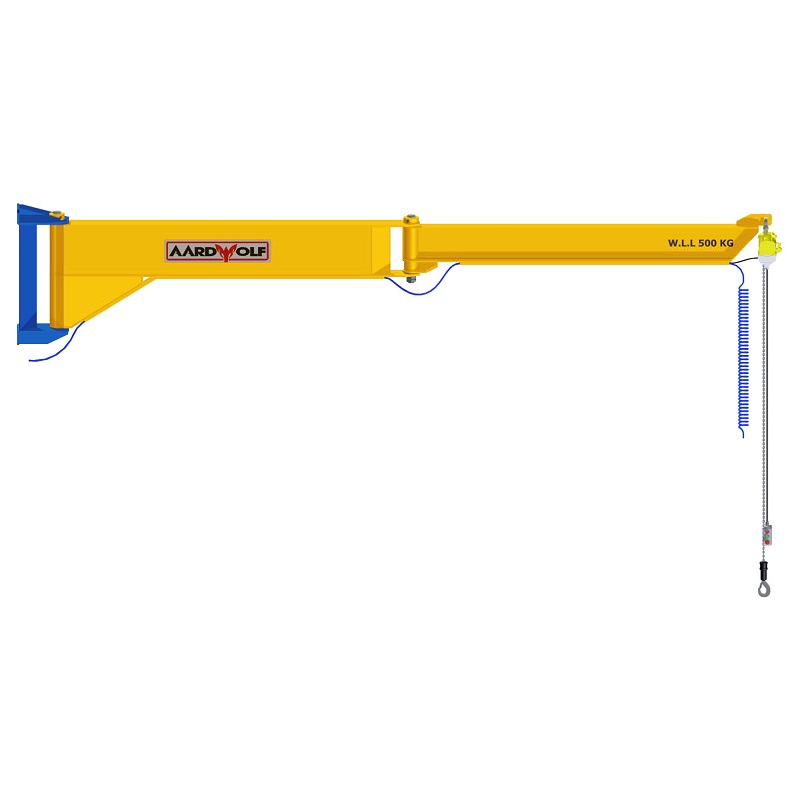
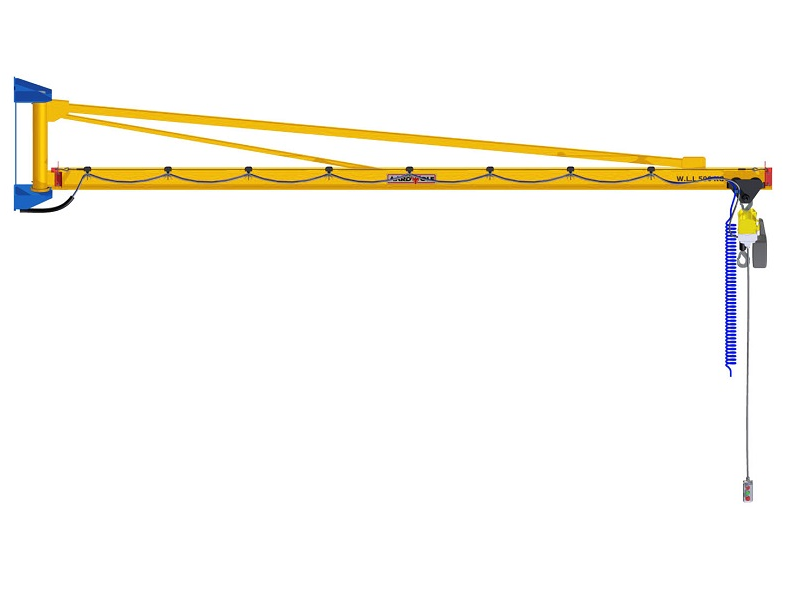
Wall-Mounted Jib Cranes
These save floor space but rely on the building’s structural strength. Higher loads may require:
- reinforced columns
- engineered brackets
- structural analysis
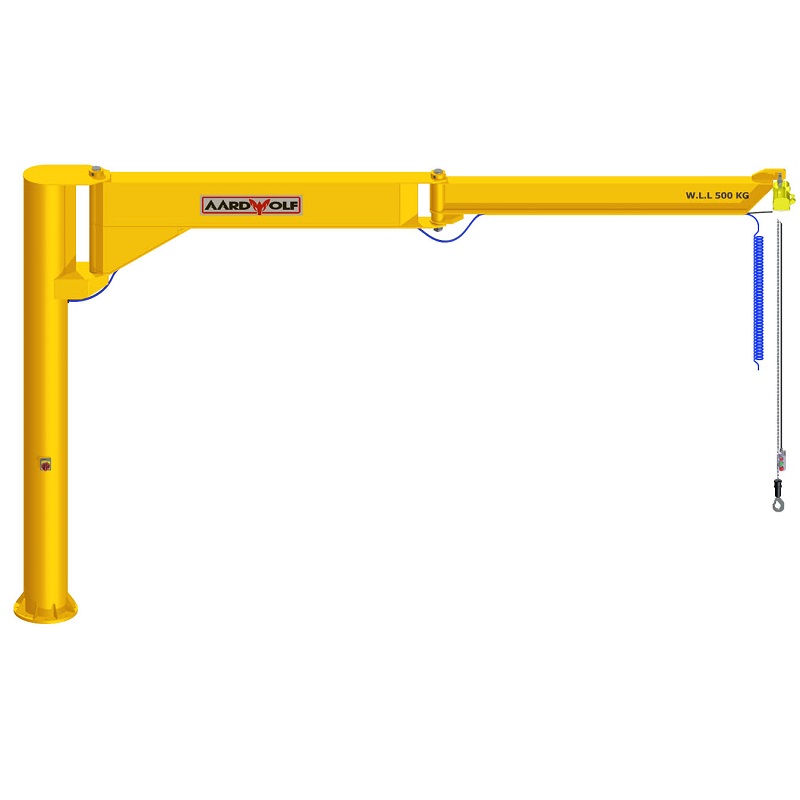
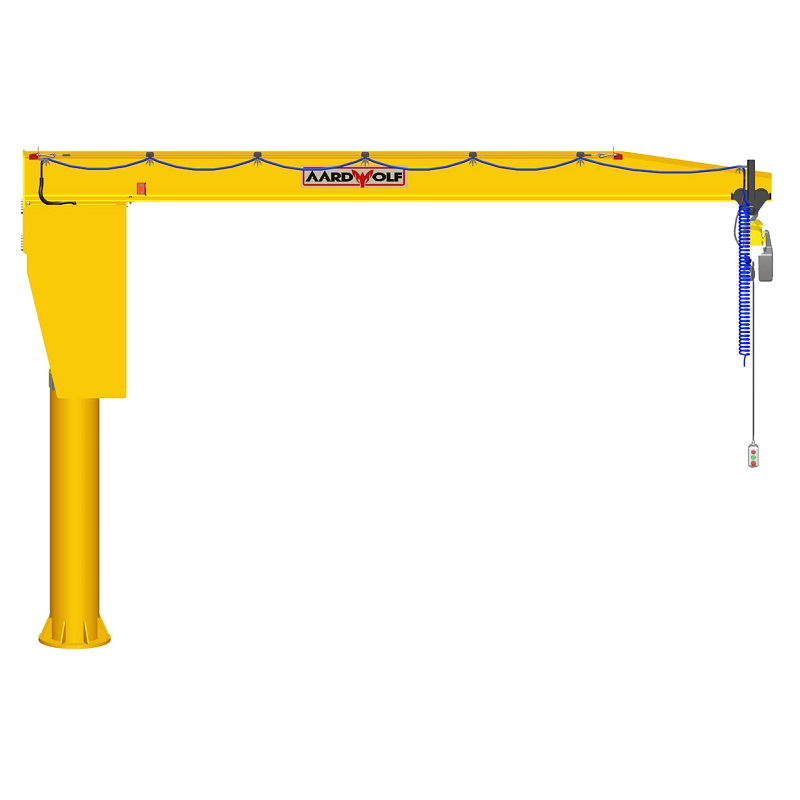
Floor-Mounted Jib Cranes
These can handle higher capacities, but require:
- reinforced concrete foundation
- stable base anchoring
- clear swing radius
Mast-Type Jib Cranes
Great option when foundations are limited but overhead structure exists.
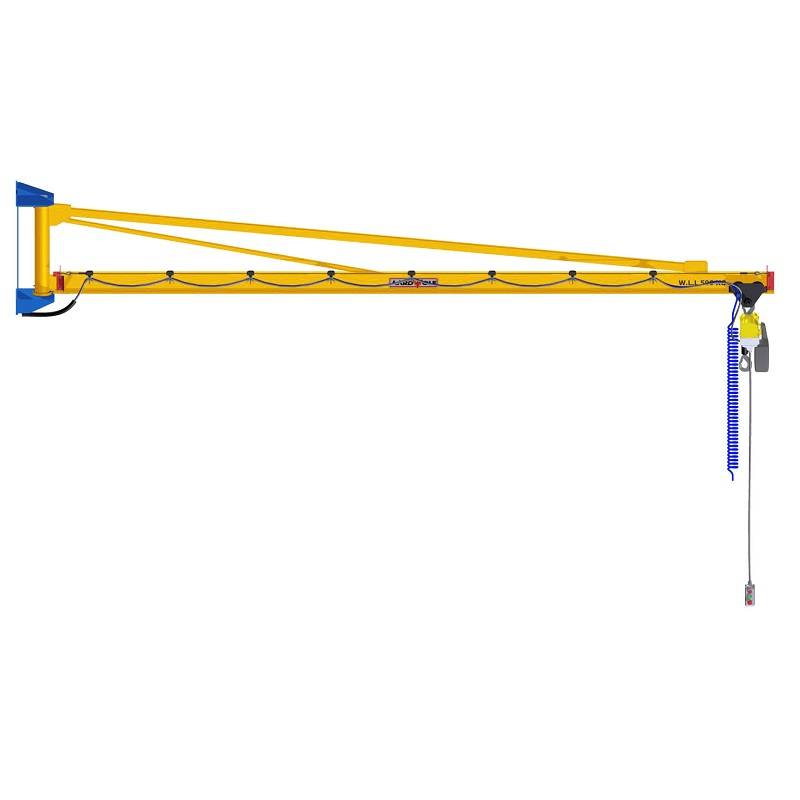
Articulated Jib Cranes
Excellent for precision in tight spaces, but typically used for lighter to mid-range loads.
If you need obstacle avoidance and precise movement for real operations, consider:
👉 Articulated Jib Crane – Wall Mounted
For more available jib crane models and configurations:
👉 more crane products
How to Select the Right Jib Crane Load Capacity (A Real-World Process)
Here’s a practical step-by-step method based on real industrial selection:
Step 1: Identify the Heaviest Lift (Including Rigging)
Don’t estimate—list:
- max load
- lifting device weight
- slings/hooks/spreaders
- typical load variations
Step 2: Add a Realistic Safety Margin
Most operations use a 10–20% margin, but heavy-duty or outdoor lifting may require more.
Step 3: Confirm Workspace Limits (Reach + Height)
Capacity is pointless if:
- boom can’t reach the load point
- lifting height doesn’t clear obstacles
- rotation is restricted
Step 4: Match Capacity to Frequency (Duty Cycle)
A crane lifting 1 ton once a day is different from lifting 1 ton every 5 minutes.
If usage is high-frequency:
- choose higher duty class
- choose stronger hoist systems
- plan for more maintenance intervals
Step 5: Choose Mounting Style Based on Facility Strength
Wall-mounted cranes require structural confirmation.
Floor-mounted cranes require foundation readiness.
Why Capacity Can Change Over Time (And Why Real Operations Must Monitor It)
Even if the crane is correctly rated at installation, capacity safety can degrade due to:
- metal fatigue
- corrosion
- worn bearings
- hoist brake wear
- loose anchor bolts
- structural deflection changes
That’s why reassessment matters—especially for older cranes:
👉 Why Old Jib Crane Load Capacity Needs Reassessment?
On-Site Tools That Help Confirm Capacity and Prevent Overload
In real facilities, operators and maintenance teams can use tools like:
- load cells / dynamometers
- deflection measuring tools
- torque wrenches
- crack inspection kits
- hoist brake testing methods
- inspection logs for compliance
These tools support early detection and improve safety.
👉 What Jib Crane Load Capacity Tools Are Used On-Site
The Maintenance Factor: Capacity Depends on What You Maintain
A crane that is not maintained loses reliability—even if its nameplate rating never changes.
Poor lubrication, neglected inspections, and worn hoists all reduce safe handling performance.
To understand how maintenance supports capacity long-term:
👉 What Jib Crane Load Capacity Depends on Proper Maintenance
Common Real-World Mistakes That Reduce Capacity Safety
Here are issues that cause many crane incidents:
❌ Underestimating load weight
Operators rely on visual guesses instead of actual weight measurement.
❌ Ignoring rigging weight
Slings, spreaders, and hooks add significant weight.
❌ Side pulling
Side loads increase structural stress and can tip wall-mounted cranes.
❌ “It lifted last time” mentality
Capacity problems often appear gradually.
❌ Skipping inspections
Small wear becomes structural failure when ignored.
FAQs About Jib Crane Load Capacity in Real Applications
What is the most common jib crane load capacity for general workshops?
Typically 0.5 ton to 5 tons, depending on the industry and load type.
Why can a crane fail even under its rated load?
Because real-world conditions introduce:
- shock loading
- side loading
- wear and corrosion
- poor maintenance
- incorrect installation
Should I buy a higher capacity crane “just in case”?
Only if:
- the structure supports it
- your budget can justify it
- your operations are likely to scale
Otherwise, oversizing may cause unnecessary costs and installation complexity.
Conclusion: Jib Crane Load Capacity Is More Than a Number
In real-world environments, jib crane load capacity influences everything: workflow speed, operator confidence, safety performance, maintenance cost, and compliance readiness.
The key is to select capacity based on:
✅ real load weight + rigging
✅ workspace constraints
✅ duty cycle and frequency
✅ mounting limitations
✅ long-term maintenance planning
And once installed, capacity must be supported through ongoing monitoring, inspection tools, and reassessment—especially as the crane ages or workload grows.
To strengthen your capacity planning and real-world safety strategy, explore these related guides:
- 👉 Why Old Jib Crane Load Capacity Needs Reassessment?
- 👉 What Jib Crane Load Capacity Depends on Proper Maintenance
- 👉 What Jib Crane Load Capacity Tools Are Used On-Site
And for product options:
Please log in to leave a comment.